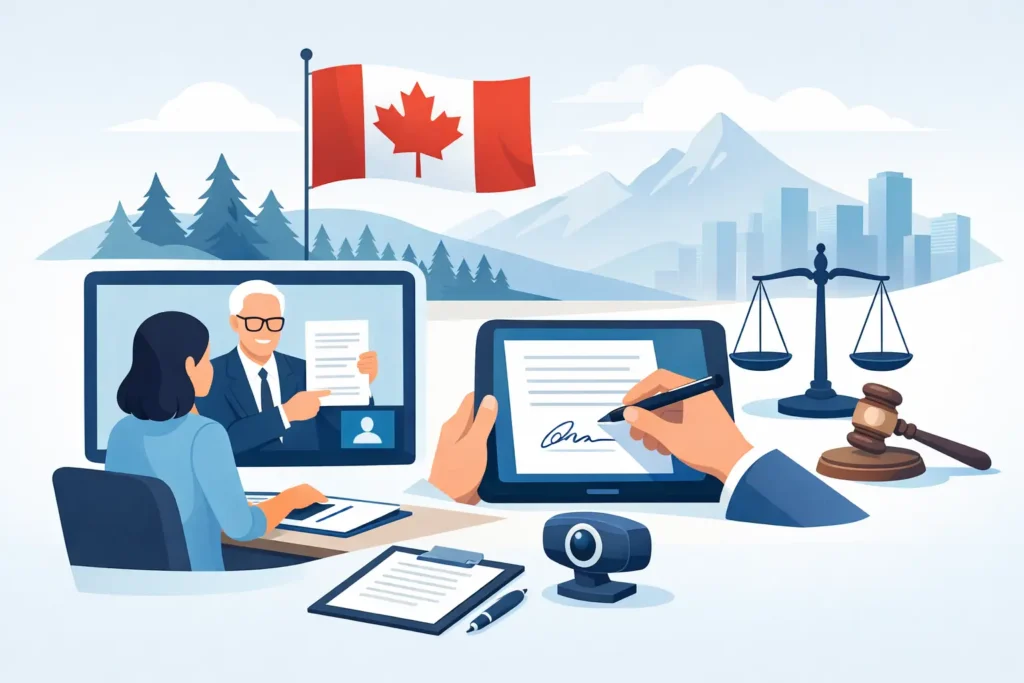
A document can be perfectly signed on video and still be rejected later by a bank, court, registry, insurer, or foreign authority. So, is remote witnessing legal Canada? Sometimes – but the answer depends on the document, the province or territory involved, how the signing is completed, and who will rely on it.
For Calgary and Alberta clients, the practical question is not simply whether a video call is available. It is whether remote witnessing is permitted for that specific document and whether every legal condition has been met. When timing matters, an in-person mobile appointment is often the clearest way to avoid a preventable problem.
Is Remote Witnessing Legal in Canada?
Canada does not have one universal rule for remote witnessing. Provinces and territories control many rules governing wills, powers of attorney, affidavits, declarations, land documents, and other signed records. Federal requirements can also apply to certain government forms and cross-border transactions.
Remote witnessing generally means a witness observes a person sign through real-time audio-video technology rather than standing in the same room. It is different from sending someone a signed PDF afterward, watching a recording, or simply confirming by phone that a signature was made. Those methods usually do not meet a true witnessing requirement.
Some Canadian jurisdictions introduced virtual signing measures during the pandemic and later made certain options permanent. Others limit remote witnessing to particular document categories or require specific safeguards. A rule that works for a will may not apply to an affidavit, a real estate document, or a form being used outside Canada.
The short answer is yes, remote witnessing can be legal in Canada. The reliable answer is that it depends.
Remote Witnessing Is Not the Same as Remote Notarization
These terms are often used interchangeably, but they describe different legal acts.
A witness is usually confirming that they saw the signer execute the document and, in some cases, that the signer appeared to understand what they were signing. A commissioner for oaths administers an oath or affirmation for affidavits, statutory declarations, and similar documents. A notary public may verify identity, witness signatures, certify copies, and complete notarial certificates needed for domestic or international use.
Each role has separate legal requirements. A document may permit remote witnessing but still require an in-person oath. Or it may be validly witnessed online but unacceptable to the organization receiving it because that organization requires a wet-ink original or an in-person notarial certificate.
This distinction matters most for urgent documents. Before arranging a video signing, confirm what the recipient actually requires. Ask whether electronic signatures are accepted, whether the witness may participate remotely, whether original paper must be submitted, and whether notarization or commissioning is required.
When Virtual Witnessing May Work
Remote witnessing is more likely to be available when legislation or a current regulation specifically authorizes it and the signing process follows the stated safeguards. In Alberta, estate planning documents and other instruments may have rules that differ from those in another province.
Where virtual witnessing is permitted, the process commonly requires real-time audio-video communication. The witness needs to watch the signer sign, not receive a copy afterward. The parties may need to sign matching counterparts, complete certificates in a prescribed way, retain recordings or records, or use a professional who is authorized to supervise the process.
Identity verification also matters. A clear view of government-issued identification may be part of the process, but it is not the whole process. The person witnessing or commissioning the document must be satisfied about identity and must be alert to signs that someone is being pressured, coached, or prevented from understanding the document.
A remote process is usually a poor fit when the signer has limited technology, an unstable connection, a language barrier, questions about capacity, or family members who may later challenge the document. Those circumstances do not automatically make virtual witnessing impossible, but they raise the risk of a later dispute.
Wills and estate planning documents
Wills are one of the most common reasons people ask about virtual witnessing. Many provinces have modernized their rules in this area, but the details are not interchangeable. Witness eligibility still matters, and a beneficiary or a beneficiary’s spouse may create issues depending on the applicable law.
An enduring power of attorney and a personal directive can be even more sensitive. These documents give someone significant authority over property, finances, or personal decisions. Requirements relating to witnesses, capacity, independence, and execution can be strict. Do not assume that a remote will-signing option automatically extends to these documents.
Affidavits and statutory declarations
Affidavits and statutory declarations require more than a signature. The deponent must swear or affirm that the content is true before an authorized commissioner for oaths or notary public. Whether this can occur remotely depends on the law governing the oath and the receiving organization’s rules.
Courts, government departments, insurers, and legal counsel may have their own filing standards. If an affidavit supports litigation, a land matter, probate application, or immigration-related process, verify the exact requirement before execution. A rejected affidavit can mean missed deadlines and additional expense.
Real estate, corporate, and cross-border documents
Real estate and registry documents often have tightly controlled signing and identity rules. Lenders and title-related professionals may require original signatures, in-person verification, or a particular form of acknowledgment. Corporate resolutions may be more flexible, but financial institutions often impose their own standards.
Cross-border documents require another level of care. A U.S. company, foreign consulate, overseas court, or international registry may not recognize a Canadian remote witnessing process, even if it was valid where it was completed. If apostille or authentication is needed, the original notarization format can affect the next step.
A Practical Check Before You Sign Remotely
Remote signing should be treated as a legal process, not just a convenience feature. Before moving ahead, get clear answers to these questions:
- What exact document are you signing, and which province or territory governs it?
- Is remote witnessing expressly permitted for that document type?
- Does the receiving organization accept electronic signatures, scanned copies, or counterpart signatures?
- Does the document require a witness, a commissioner for oaths, a notary public, or all of these?
- Are there special witness eligibility rules, such as independence from beneficiaries or family members?
- Will the document be used outside Alberta, outside Canada, or in a court or registry setting?
If the answer to any of these questions is uncertain, do not guess. Request written requirements from the receiving organization or speak with the legal professional handling the matter. This is especially worthwhile for estate documents, property transfers, family law documents, immigration filings, and documents that could affect significant money or decision-making authority.
Why In-Person Witnessing Is Often the Better Choice
Remote witnessing can save travel time, but in-person execution remains the simpler route for many important documents. Everyone can review the original paper together, identification can be checked directly, signatures can be completed in the correct order, and the document can leave the appointment fully executed.
It also reduces the administrative friction that causes delays. There is no uncertainty about whether the camera view was clear, whether the witness saw the signature occur, whether pages were mixed up, or whether counterparts need to be assembled later. For seniors, hospital patients, busy business owners, and families managing an urgent estate matter, that certainty can be worth more than the convenience of a video call.
Mobile service is particularly useful when getting to an office is the obstacle. A professional can meet you at home, a workplace, hospital, care facility, or another suitable location and help ensure the signing process is handled carefully. Notary2U provides mobile and in-office document support in Calgary and surrounding Alberta communities for clients who need a practical, properly organized alternative to remote uncertainty.
Common Mistakes That Put Documents at Risk
The most frequent mistake is assuming a digital signature makes every document electronic. It does not. Another is having a witness sign later after being told that the signer signed earlier. A witness generally needs to observe the act of signing in the manner the law requires.
People also overlook the recipient’s requirements. A private company may accept a remote-witnessed document while a government office, bank, court, land registry, or foreign authority refuses it. Validity and acceptability are related, but they are not always the same thing.
Finally, do not treat a commissioned document as automatically notarized, or a notarized document as automatically eligible for apostille or foreign legalization. Each stage has its own rules, and correcting an execution error later can require starting over.
When a document will affect your property, legal rights, family, business, or ability to travel, choose the execution method that the recipient will recognize without hesitation. A quick signing is helpful only when it holds up when the document is needed.