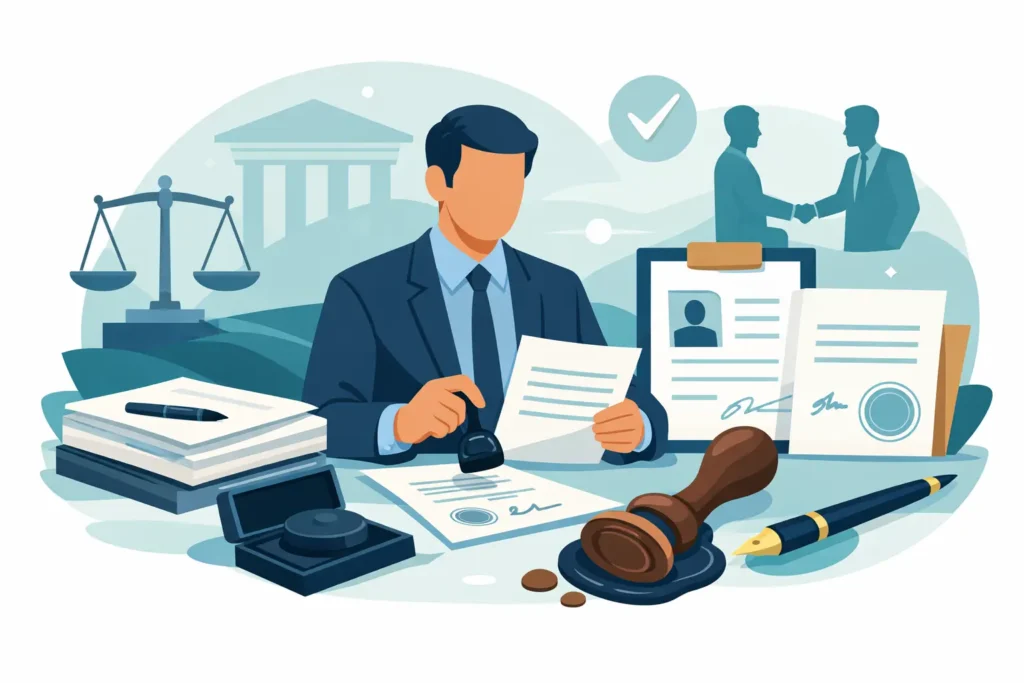
An unsigned affidavit can stop a court filing, delay an insurance claim, or hold up a personal matter that needs to move now. This guide to commissioner for oaths services explains what happens at an appointment, what to bring, and how to avoid the small mistakes that force you to start again.
For many Alberta documents, the process is straightforward: bring valid identification, understand what you are signing, and sign only when the commissioner directs you to do so. The details matter because an oath or affirmation is not simply a signature. It is a formal declaration that the statements in your document are true to the best of your knowledge and belief.
What Does a Commissioner for Oaths Do?
A commissioner for oaths is authorized to administer oaths and affirmations and to receive certain declarations. In practical terms, they witness you sign a document after you swear or affirm that its contents are true.
This service is commonly needed for affidavits, statutory declarations, consent forms, insurance documents, name-related applications, court forms, and other paperwork that contains a jurat or declaration section. The wording near the signature block often tells you whether an oath, affirmation, or declaration is required.
An oath is traditionally made with a religious reference. An affirmation has the same legal effect but does not use religious language. You can generally choose the option that is right for you.
A commissioner is not there to decide whether your statements are accurate, write your affidavit for you, or provide legal advice about what you should say. Their role is to confirm your identity, administer the oath or affirmation, witness your signature, and complete the required commissioning section.
Commissioner for Oaths vs. Notary Public
People often use these terms interchangeably, but they are not the same service. Choosing the right one before your appointment can save a second trip and an unnecessary delay.
A commissioner for oaths is often the appropriate choice when a document must be sworn or affirmed for use in Alberta or another Canadian context that accepts commissioning. An affidavit for a local matter is a common example.
A notary public has a broader role. Notarial services may be required for certified true copies, documents being used outside Canada, foreign powers of attorney, corporate records, or paperwork that a bank, government agency, school, consulate, or overseas recipient specifically says must be notarized. International documents may also require further authentication or apostille coordination after notarization.
The instructions from the organization receiving your documents should lead the decision. If they say “sworn before a commissioner for oaths,” commissioning is likely what you need. If they say “notarized,” “certified copy,” or “for use abroad,” ask for notary support instead. When the instructions are unclear, bring them with you or send them before booking so the right service can be arranged.
Documents Commonly Signed Before a Commissioner
Commissioning is often used for documents where you are making a statement of fact under oath or affirmation. Examples include affidavits for court or administrative matters, statutory declarations, proof-of-residency statements, lost-document declarations, insurance forms, and certain family, estate, or property-related forms.
However, the document itself must be suitable for commissioning. Some forms have specific rules about who can witness them. A form may require a lawyer, a notary public, a particular government official, or a witness who meets defined eligibility requirements. A commissioner cannot replace a required specialist simply because there is a signature line on the page.
This is especially relevant when documents will be used in the United States or another country. U.S. agencies often use notarial certificates and may not accept a Canadian commissioner’s stamp. A document that will cross a border should be reviewed against the receiving organization’s written requirements before it is signed.
What to Bring to Your Appointment
Preparation is the fastest way to keep a commission appointment short and stress-free. Bring the complete, final version of the document, including every page and any exhibits or attachments it refers to. If an affidavit says “attached as Exhibit A,” make sure Exhibit A is actually there.
You will also need current government-issued photo identification. A driver’s license, passport, or other acceptable government photo ID is commonly used to confirm identity. Your name on the identification should match the name used in the document. If it does not, bring supporting documentation and raise the issue before signing.
Do not pre-sign the affidavit, statutory declaration, or jurat section. The commissioner needs to witness your signature. If you have already signed it, you may need to print a fresh copy and sign again in the commissioner’s presence.
Read the document before the appointment. You should understand each statement you are swearing or affirming. If there are blanks, complete them where appropriate before arriving, but leave the signature and commissioning sections untouched unless you have been instructed otherwise.
For a smooth appointment, have these items ready:
- Your unsigned, complete document and all attachments
- Valid government-issued photo identification
- Any instructions from the court, agency, employer, or other recipient
- Supporting documents for a name difference or related detail, if applicable
What Happens During the Signing Process?
The appointment is usually quick, but it is a formal process. The commissioner reviews your identification and confirms that you understand the document. You may be asked whether the contents are true to the best of your knowledge and belief and whether you wish to swear an oath or make an affirmation.
Once the oath or affirmation has been administered, you sign the document in front of the commissioner. The commissioner then completes the jurat or declaration section, signs, and applies their stamp or other required information.
Dates, locations, names, and exhibit references must be consistent. A missed page number, incomplete attachment, or incorrect date can create problems later, particularly when the document is being filed or submitted under a deadline. Take a moment to review the completed document before leaving.
When Mobile Commissioner Service Makes Sense
A mobile appointment is useful when getting to an office is the hard part of the task. You may be managing a hospital visit, caring for a family member, closing a time-sensitive business matter, coordinating documents among several signers, or trying to meet a same-day filing deadline.
A commissioner can meet you at a home, workplace, hospital, care facility, coffee shop, or another suitable location, provided the setting allows the document to be reviewed and signed properly. Privacy matters. For documents involving personal financial, health, family, or legal information, choose a location where you can speak freely and keep paperwork secure.
Mobile service is not always the best option. If you need to sign several original sets, require certified copies, or have international documents that may need notarization and authentication, an in-office appointment may be more efficient. The right choice depends on the document, number of signers, deadline, and destination of the paperwork.
Common Mistakes That Cause Delays
The most common issue is signing too early. A commissioner must witness the signature, so keep the document unsigned until the appointment.
Another frequent problem is assuming every form can be commissioned. A form may have a specific witness requirement, and the receiving organization has the final say on what it accepts. Always follow the written instructions provided with the form.
Incomplete documents also create avoidable delays. Review page counts, attachments, exhibit labels, and blank fields before meeting. If two people must sign, make sure both are present with identification unless the document instructions clearly allow separate execution.
Finally, do not treat commissioning as legal review. If you are unsure what an affidavit means, whether you should make a statement, or how a legal form should be completed, seek legal guidance before swearing it. Once you take an oath or affirmation, you are responsible for the truthfulness of what you sign.
Getting Your Documents Completed Without Extra Runs Around
When time is tight, share the document type, number of signers, location, and deadline when arranging service. Mention whether the paperwork is for Alberta, another Canadian province, the United States, or another country. That information helps confirm whether you need a commissioner for oaths, a notary public, certified copies, translation, or additional document handling.
Notary2U can help Calgary and Alberta clients arrange practical, professional support around the real-world demands of important paperwork, including mobile and same-day options where available. The goal is simple: arrive prepared, sign correctly, and leave with documents ready for their next step.
The best time to confirm the right witnessing service is before ink touches the page. A few minutes of preparation can protect a filing date, avoid a rejected document, and let you get back to the matter that cannot wait.