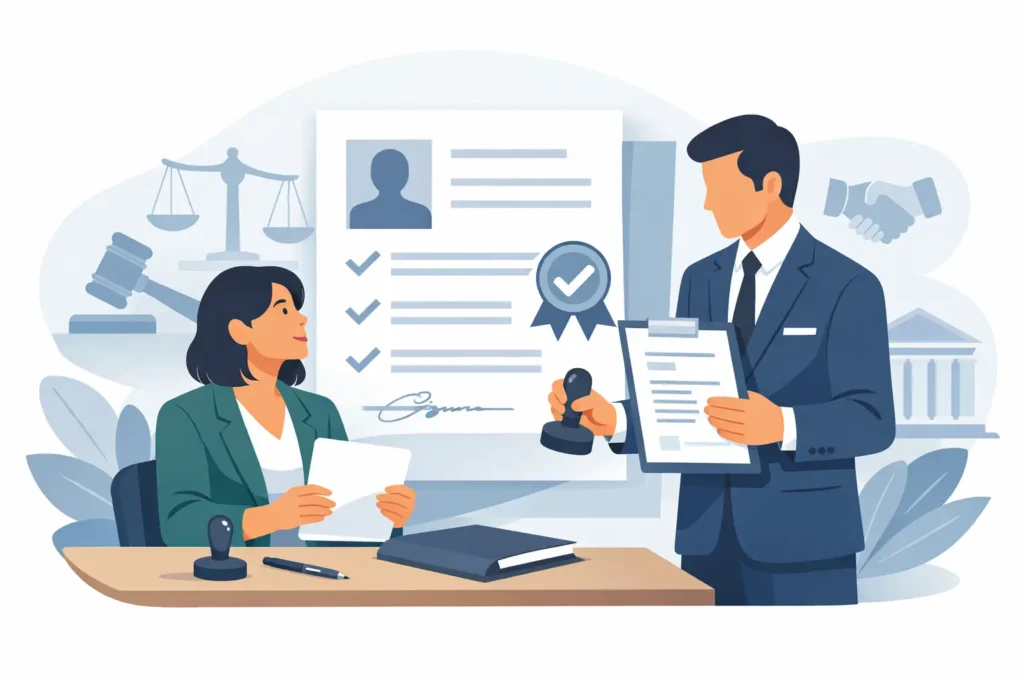
A form can be complete, signed, and still be rejected because it was signed in the wrong way. If the instructions say the document must be “sworn,” “affirmed,” or “declared before a commissioner,” the question is clear: when is a commissioner needed? You need one when a person must formally confirm that the information in a document is true before an authorized official.
This comes up often with affidavits, statutory declarations, government forms, court-related paperwork, insurance claims, estate documents, and professional applications. The key is knowing whether your document needs a commissioner for oaths, a notary public, a witness, or another specific official before you sign.
When Is a Commissioner Needed?
A commissioner for oaths is needed when a document requires a sworn statement or solemn declaration. Their role is to administer an oath or affirmation, confirm that you are signing voluntarily, and complete the required jurat or declaration section on the document.
In practical terms, you may need a commissioner when the form includes wording such as:
- “Sworn before me”
- “Declared before me”
- “Affirmed before me”
- “Commissioner for Oaths”
- “This affidavit must be sworn”
An affidavit is a written statement that you swear or affirm is true. A statutory declaration is similar, but instead of taking an oath, you solemnly declare that the contents are true. Both carry legal consequences. Signing one falsely can expose you to penalties, which is why the signing must happen in front of an authorized official.
A commissioner does not simply stamp paperwork after the fact. You must appear before the commissioner, show valid identification, and sign only when instructed. If you have already signed the document, you may need to complete a new signature in the commissioner’s presence.
Common Documents That Need a Commissioner
The wording on the form always controls, but commissioners are commonly used for affidavits and declarations connected to personal, legal, and administrative matters.
For example, you may need a commissioner for an affidavit of identity, a lost-document declaration, a proof-of-residency statement, an insurance declaration, a name-change-related affidavit, or a declaration supporting an application. Commissioners are also frequently needed for court forms, family law paperwork, estate administration documents, pension or benefit declarations, and statements required by employers or professional organizations.
In Alberta, many forms intended for use within the province can be sworn before a commissioner for oaths. However, the organization receiving the document may set its own rules. A court, government department, bank, foreign authority, lawyer, or title office may require a notary public instead. Never assume that any stamp will do.
Commissioner for Oaths vs. Notary Public
The fastest way to avoid delays is to understand the difference before booking an appointment.
A commissioner for oaths is generally used to witness sworn statements, affirmations, and statutory declarations. Their authority is focused on administering oaths and taking declarations. This is often the right, efficient option for documents that will be used locally in Alberta or elsewhere in Canada, provided the receiving party accepts a commissioner.
A notary public has broader authority. A notary may administer oaths, but can also notarize documents, verify identities, certify true copies where permitted, and complete notarial certificates for documents being presented outside Canada. Documents for a U.S. institution, foreign government, overseas school, international business transaction, or apostille process commonly need notarization rather than a commissioner’s signature.
There is overlap, but the services are not interchangeable. If a form specifically requests a notary public, a commissioner is not the substitute. If the form requests a commissioner for oaths, a notary may still be accepted in some situations, but it is better to confirm with the receiving organization first.
When a Notary Is Usually the Better Choice
Choose a notary when the document requires a notarial certificate, a certified true copy, or authentication for use outside Canada. The same is true for many cross-border matters, including powers of attorney being used in the United States, foreign property documents, international consent letters, corporate records, and documents that may need an apostille or further legalization.
A notary may also be the safer choice when the instructions are vague but the document is headed overseas. Foreign authorities may not recognize a Canadian commissioner for oaths, while notarization is more widely understood and accepted.
What to Bring to Your Appointment
Bring the original unsigned document, unless the receiving party has clearly instructed you otherwise. You should also bring current government-issued photo identification, such as a driver’s license or passport. The name on your ID should match the name on the document.
Read the form before the appointment, but do not sign the affidavit, declaration, or signature block that must be witnessed. If there are blank fields, complete them as much as possible ahead of time. A commissioner can explain the signing process, but cannot provide legal advice or tell you what statements to make in your affidavit.
If you are unsure whether the document requires a commissioner or notary, bring the instructions from the receiving organization. An experienced document services provider can review the wording and help identify the proper service before the document is executed.
Important Limits of a Commissioner’s Role
A commissioner confirms that you made the oath, affirmation, or declaration. They do not verify that every statement in your document is factually true. You remain responsible for the contents.
They also cannot act where there is a conflict of interest or outside the scope of their authorization. Some commissioners have restrictions based on their employment or the types of documents they can handle. That is another reason to use a professional service when the document is important, time-sensitive, or being submitted to a government body, court, or institution.
A commissioner is not a lawyer. If you need help deciding what an affidavit should say, understanding the legal effect of a declaration, or preparing court materials, get legal advice before signing. The commissioner’s role begins when the wording is complete and you are ready to swear or affirm that it is true.
Avoid These Common Signing Mistakes
The most common mistake is signing too early. Affidavits and declarations generally must be signed in front of the commissioner. A second common mistake is using the wrong official because the person signing did not check the receiving party’s requirements.
People also run into trouble by leaving essential blanks in the form, bringing expired identification, or assuming a witness is the same as a commissioner. A witness observes a signature. A commissioner administers an oath or affirmation. Some documents need both, and they may require different people to perform each role.
For urgent paperwork, mobile service can make a meaningful difference. Instead of delaying a filing because you cannot leave work, a hospital, your home, or a care facility, a qualified commissioner can meet you at a practical location. Notary2U provides mobile and in-office commissioner for oaths and notary services in Calgary, with flexible scheduling for documents that cannot wait.
Before you sign, take one final look at the form’s exact instructions and ask the receiving organization whether a commissioner is accepted. That small check can save you from having to redo the document, miss a deadline, or pay for a second appointment.