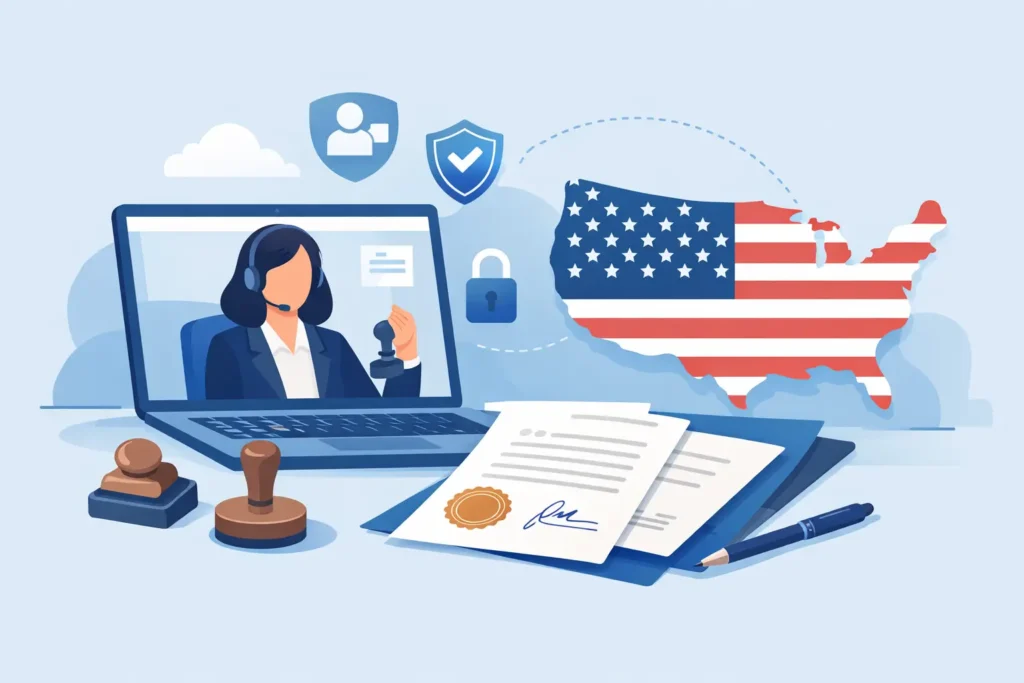
A document can look simple until the receiving party rejects it for one missing notarization detail. That happens often with cross-border paperwork, especially when someone in Canada needs a virtual notary for USA documents and assumes any online signing session will do. It will not. U.S. document requirements vary by state, by document type, and by the organization requesting it.
If you are handling a power of attorney, affidavit, real estate form, consent letter, corporate record, or estate document for use in the United States, the first question is not just whether it can be notarized online. The real question is whether the receiving authority will accept that specific type of notarization from your location, in the format you are using, on the timeline you have.
When a virtual notary for USA documents makes sense
Virtual notarization can be a practical option when the document recipient allows remote online notarization and the signer can meet the identity verification requirements. For many clients, that means avoiding courier delays, office travel, and scheduling issues. If you are signing from Alberta for a U.S.-bound matter, the convenience is obvious, especially when the matter is urgent.
That said, convenience only matters if the notarization is valid for the purpose you need. Some U.S. institutions are comfortable with remote online notarization completed through an approved U.S. notary platform. Others still ask for wet signatures, in-person notarization, or additional authentication steps. A county recorder, title company, court, bank, or private attorney may each apply different standards.
This is where people lose time. They focus on finding any notary instead of confirming the exact acceptance standard first.
Not every U.S. document follows the same rule
There is no single answer for all U.S. paperwork. A virtual notary for USA documents may work well for one file and fail completely for another.
Real estate documents are a good example. Some states, lenders, and title companies accept remote notarization for certain closings or supporting forms. Others require stricter procedures or insist on a local in-person signing. Estate planning documents can be just as inconsistent. A power of attorney may be accepted remotely in one situation but questioned in another if witnesses, state-specific language, or recording rules were not handled properly.
Business documents are often easier, but not always. Corporate resolutions, sworn statements, and authorization forms may be accepted quickly if the receiving party is familiar with remote notarization. On the other hand, immigration-related forms, court filings, and vital records matters can have tighter rules or separate certification requirements.
The safest approach is simple. Confirm what the end user wants before the document is signed. Ask whether they accept remote online notarization, whether the notary must be commissioned in a particular state, whether witnesses are required, and whether the final document must be paper, electronic, or both.
What to confirm before booking a virtual notary for USA documents
A little preparation prevents expensive rework. Before you schedule anything, verify four things with the receiving party.
First, ask if remote online notarization is acceptable for your exact document. Do not rely on general statements from a website or a friend’s past experience.
Second, confirm who can perform the notarization. In some cases, the document recipient expects a U.S. notary commissioned in a state that permits remote notarization. In other situations, a Canadian notarization may still be useful, but only if paired with further authentication.
Third, ask about identity requirements. Remote sessions often require government-issued ID, knowledge-based authentication, credential analysis, and a stable internet connection. If your name does not match the document exactly, or your ID is expired, the session may fail.
Fourth, ask whether the document needs anything beyond notarization. Some U.S. documents used across borders may later need authentication, apostille-related handling, certified translation, or secure courier delivery.
How the process usually works
For accepted remote notarizations, the process is usually straightforward. You upload the document, verify your identity, connect by video with the notary, confirm your intent to sign, and complete the electronic signature. The notary then applies the notarial certificate and electronic seal according to the rules of their commission.
What sounds quick on paper can still break down in practice. Names must match. Dates must be correct. Blank spaces in the document can trigger rejection. If the document requires witnesses, those must be arranged properly and approved in advance. If multiple signers are involved, each person may need separate identity verification.
That is why support matters. People dealing with cross-border documents are often juggling more than notarization. They may also need printing, scanning, translation, delivery, or help understanding whether the document should be signed at all before legal review. A service-first approach saves time because it treats the notarization as one step in a larger process, not as an isolated transaction.
Common problems that cause delays
The biggest delay is using the wrong notarization method. If the receiving organization wants an in-person notarization and you complete a remote session instead, you may need to start over.
The second common issue is incomplete instructions. Clients are often told, “just get it notarized,” without being told whether witnesses are needed, whether the notary wording must follow a certain state format, or whether the original paper document must still be mailed afterward.
Another problem is assuming all online notaries are interchangeable. They are not. A notarization’s usefulness depends on the notary’s authority, the platform used, the document type, and the recipient’s acceptance policy.
Timing also matters. If your document is tied to a closing date, court deadline, travel plan, or estate filing, even a small error can create a chain reaction. A missed signing can mean rescheduling multiple parties, paying extra courier fees, or losing valuable processing time.
When in-person support is still the better option
Sometimes the fastest path is not virtual. If the recipient wants original signatures, paper notarization, certified copies, commissioner services, or supporting document handling, an in-person appointment may be more efficient.
This is especially true for clients managing several tasks at once. Someone preparing a U.S. package may need notarization plus certified translation, affidavit support, secure delivery, or guidance on where each signed document goes next. In those cases, practical local help can reduce confusion and keep the file moving.
For clients in Alberta dealing with U.S.-bound paperwork, this is where a provider like Notary2U can make the process easier. The value is not just the signature and seal. It is the ability to sort out what the receiving party needs, arrange the proper appointment format, and handle related document services without sending clients to three different places.
Virtual notary for USA documents and cross-border reality
Cross-border documentation always comes with an extra layer of caution. Rules can change. Institutions interpret requirements differently. A valid notarization can still be rejected if it does not match internal policy.
That does not mean the process has to be difficult. It means you should treat notarization as a compliance step, not a box to check casually. Start with the end user’s requirements. Match the notarization method to the document. Make sure your ID, names, witnesses, and delivery method are aligned before the signing begins.
If you are dealing with urgent U.S. paperwork, speed matters, but accuracy matters more. The right support will help you get both. A virtual option can be an excellent fit when it is accepted and set up properly. When it is not, knowing that early is what saves you time.
The best next step is usually the simplest one: confirm exactly what the document recipient will accept, then choose the notarization method that gets it done right the first time.